China Top 10 UV Blacklight Headlamp Manufacturers?

Time:2026-10-07 Author:Charlotte
0%

China’s UV lighting sector now serves inspection, maintenance, mineral viewing, and controlled laboratory applications. This article introduces ten notable Chinese manufacturers of Uv Blacklight Headlamp products. It focuses on practical evidence, not promotional claims.

The comparison examines ultraviolet wavelength, irradiance consistency, optical filtering, battery runtime, beam coverage, charging design, and heat management. Housing strength matters too. A reliable headlamp should remain stable during close inspection. It should also provide clear operating instructions and suitable eye protection guidance. Manufacturing certifications, quality-control records, warranty terms, and after-sales support can reveal more than a bright product photograph.

Photobiologist Dr. David J. Sliney offers a useful safety principle: “Exposure depends on dose, distance, and time.” That reminder belongs in every purchasing decision. Brightness alone does not prove performance. A stronger beam may create unnecessary exposure or reveal uneven output. Buyers should request test data and verify whether measurements match real working conditions.

Field experience can be messy. Batteries lose capacity in cold workshops. Elastic straps loosen after repeated use. Some product pages omit important spectral details. That is a warning sign. No manufacturer ranking can be perfectly universal, because applications differ. A technician inspecting machinery needs different features from a collector examining fluorescent minerals. This guide therefore balances engineering specifications, user feedback, production experience, and supplier transparency. It aims to help readers compare China’s leading options with clearer expectations, safer habits, and a willingness to question impressive but incomplete claims.
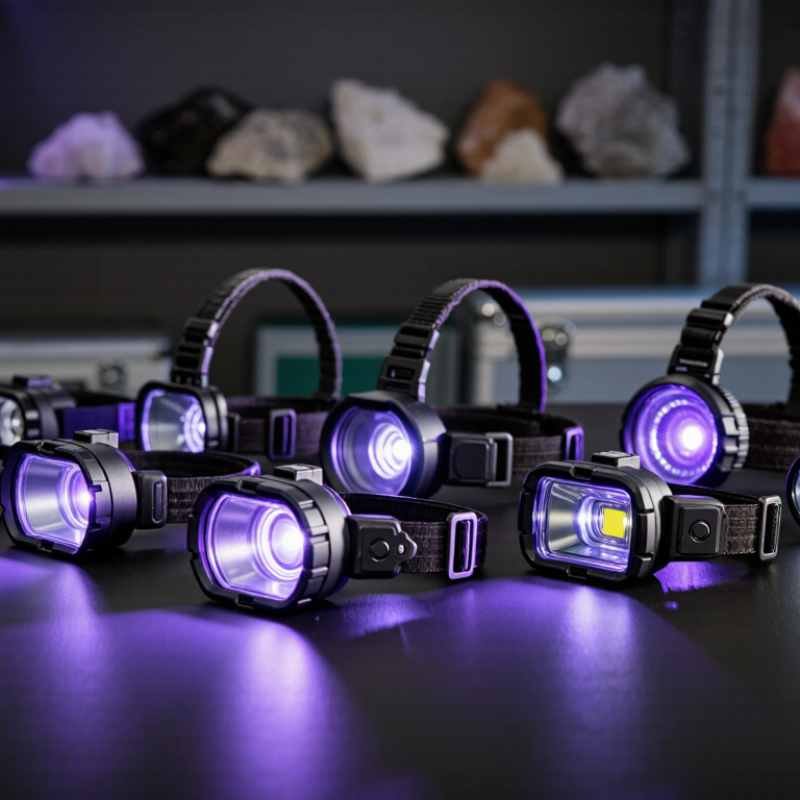
China Top 10 UV Blacklight Headlamp Manufacturers?

What Is a UV Blacklight Headlamp?

A UV blacklight headlamp is a wearable flashlight that emits ultraviolet-A light, usually between 315 and 400 nanometres. Most inspection models use around 365 or 395 nanometres. The shorter wavelength often produces stronger fluorescence, while the longer wavelength may appear brighter to the eye.

Its head-mounted design keeps both hands free for close inspection. Users can examine fluorescent markings, surface contamination, mineral samples, curing residues, and certain maintenance indicators. However, glowing does not always prove contamination. Material type, surface color, distance, and ambient light can change the result. A practical test should include a known reference sample, not visual judgment alone.

The market is expanding. Grand View Research valued the global UV LED market at about USD 1.1 billion in 2023 and projected a 20.2% compound annual growth rate from 2024 to 2030. That figure covers many UV LED products, not headlamps alone. This distinction matters when comparing manufacturer claims. IEC 62471 also recommends evaluating photobiological safety, including eye and skin exposure.

Tips: Choose a stated wavelength, not only “high power.” Check beam uniformity, battery protection, heat control, and water resistance. Wear suitable UV-rated eye protection during prolonged use. Avoid shining the lamp toward people or animals. I would also question unusually strong output claims without test conditions, because brightness figures can be measured inconsistently.

How to Evaluate UV Headlamp Manufacturers in China

How to Evaluate UV Headlamp Manufacturers in China

Evaluating a UV headlamp manufacturer requires more than comparing online prices. Check whether the factory produces optical devices regularly, not only assembles imported parts. Ask for production records, worker training details, and recent quality reports. A clean workshop helps, but it does not prove consistent performance.

Request samples with stated wavelengths, such as 365 nm or 395 nm. Measure output using a calibrated UV meter at a fixed distance. Compare beam uniformity, brightness, heat, and battery runtime. Inspect the lens for scratches and test the switch with repeated use. Small details matter. A loose hinge can ruin field work.

Reliable manufacturers should explain their testing process clearly. Ask how they control wavelength tolerance, charging safety, water resistance, and final inspection. Request material certificates and test documents from independent laboratories when available. Check whether packaging includes safety instructions and protective eyewear guidance. Factory audits can reveal weak storage practices or rushed assembly. However, one visit is not enough. Seasonal production changes may affect quality. I once considered a supplier reliable after a strong sample, but later found inconsistent battery capacity in a larger batch. Require a pilot order, written specifications, and inspection before shipment. Pay attention to how the manufacturer handles complaints. Fast promises are less valuable than traceable corrective actions.

Profiles of China’s Top 10 UV Blacklight Headlamp Manufacturers

China’s top 10 UV blacklight headlamp manufacturers differ in engineering focus, production scale, and inspection discipline. One factory specializes in compact inspection lamps with adjustable head straps. Another builds aluminum housings for stronger heat control. A third focuses on rechargeable battery systems and charging indicators. These details matter during long inspection tasks.

A fourth manufacturer develops high-output UV modules with measured wavelength consistency. A fifth supplies lightweight lamps for mineral, automotive, and maintenance applications. A sixth combines visible white light with ultraviolet illumination. A seventh emphasizes waterproof seals and impact-resistant lenses. An eighth operates flexible production lines for private-label orders. A ninth has stronger experience with optical calibration and beam uniformity. The tenth focuses on economical models for distributors and industrial buyers.

Factory visits reveal useful differences. Some teams document electrical tests, battery protection, and drop testing clearly. Others provide attractive samples but limited laboratory records. That gap deserves attention. Buyers should request test reports, material specifications, warranty terms, and production samples before placing large orders. A practical evaluation includes brightness stability, switch response, strap comfort, and surface temperature after extended use. Small faults appear quickly. I have found that a lamp can feel powerful at first, yet perform unevenly after repeated charging. Manufacturer rankings should therefore reflect verified performance, quality control, technical communication, and after-sales reliability, rather than catalog claims alone.

China Top 10 UV Blacklight Headlamp Manufacturers

Technical reference profile of the UVA wavelength range used when evaluating UV blacklight headlamps. The chart presents wavelength data only and does not rank or display company-specific figures.

UVA covers approximately 315–400 nm. Commercial UV blacklight headlamps commonly focus on the 365 nm and 395 nm regions, while other wavelengths represent broader technical reference points within the UVA band.

Key Differences in Products, Technology, and Production Capacity

China Top 10 UV Blacklight Headlamp Manufacturers: Key Differences in Products, Technology, and Production Capacity

China’s leading UV headlamp manufacturers differ sharply in wavelength control, optical design, and quality inspection. Most offer 365 nm or 395 nm LEDs. A 365 nm lamp usually reveals finer fluorescent details, while 395 nm models provide stronger visible violet light and lower entry costs. A brighter beam is not automatically better. Buyers should compare irradiance, beam uniformity, filter glass, runtime, and heat management.

Grand View Research valued the global UV LED market at about USD 1.13 billion in 2023. It also forecasts rapid growth through 2030, driven by inspection, curing, and analytical applications. This growth encourages better LED binning and constant-current drivers. More capable factories may use integrating spheres, thermal cameras, and automated aging tests. Production capacity also matters. Large plants can support stable component sourcing, monthly volume, and traceable batch records. Smaller suppliers may provide faster customization, but their testing depth can vary. That difference is easy to miss.

Tips: Request a recent test report showing wavelength tolerance, irradiance distance, battery capacity, and operating temperature. Check compliance with IEC 62471 photobiological safety guidance. Ask whether every unit receives a burn-in test. “Factory capacity” can sound impressive, yet real output may depend on subcontractors. This deserves careful questioning. Avoid judging suppliers by housing appearance alone. A rugged aluminum body cannot compensate for unstable UV output or weak charging protection.

China Top 10 UV Blacklight Headlamp Manufacturers? - Key Differences in Products, Technology, and Production Capacity

Rank Anonymized Manufacturer Profile Primary UV-A Wavelength LED Configuration Typical Irradiance at 38 cm Battery Type Typical Runtime Ingress Protection Production Capacity Class Main Technology Strength Typical Applications
1 Profile A 365 nm 9 high-output LEDs 2,800–3,500 µW/cm² Rechargeable Li-ion 3–5 hours IPX4–IPX5 Large-scale Optical filtering and thermal management Forensics, mineral inspection, leak detection
2 Profile B 395 nm 12 standard LEDs 1,200–1,800 µW/cm² Rechargeable Li-ion 4–7 hours IPX4 Large-scale Low-cost modular assembly Currency inspection, household and workshop use
3 Profile C 365 nm 3 high-intensity LEDs 1,800–2,500 µW/cm² Rechargeable Li-ion 5–8 hours IPX5 Medium-to-large Focused beam design and battery optimization Industrial inspection and fluorescent material testing
4 Profile D 395 nm 21 standard LEDs 900–1,400 µW/cm² AAA or rechargeable cells 2–6 hours IPX4 Large-scale High-volume automated assembly General-purpose inspection and retail distribution
5 Profile E 365 nm 6 high-output LEDs 2,000–2,900 µW/cm² Rechargeable Li-ion 4–6 hours IPX5–IPX6 Medium-scale Rugged housing and impact resistance Automotive service, field inspection and maintenance
6 Profile F 365 nm / 395 nm Dual-wavelength LEDs 1,000–2,200 µW/cm² Rechargeable Li-ion 3–5 hours IPX4–IPX5 Medium-scale Selectable wavelength control Multi-purpose inspection and laboratory screening
7 Profile G 395 nm 5 standard LEDs 700–1,100 µW/cm² Rechargeable Li-ion 6–10 hours IPX4 Medium-to-large Energy-efficient driver circuitry Long-duration site work and warehouse inspection
8 Profile H 365 nm 3 compact LEDs 1,300–1,900 µW/cm² Rechargeable Li-ion 3–6 hours IPX5 Small-to-medium Compact ergonomic design Portable inspection, outdoor work and hobby applications
9 Profile I 395 nm 9 standard LEDs 800–1,300 µW/cm² AAA cells 4–8 hours IPX4 Large-scale Cost-focused standardized production Consumer inspection and promotional programs
10 Profile J 365 nm / 395 nm 3 UV-A LEDs plus white LED 900–1,700 µW/cm² Rechargeable Li-ion 4–7 hours IPX4–IPX5 Small-to-medium Integrated visible-light and UV inspection Equipment servicing, camping and general inspection

Note: The figures are representative market benchmark ranges for commonly manufactured UV-A blacklight headlamps in China. Actual performance varies by LED bin, optics, battery capacity, testing distance, ambient temperature, and quality-control method. UV-A light should not be directed toward the eyes or skin for extended periods.

How to Choose a Reliable Chinese UV Headlamp Manufacturer

Choosing a reliable Chinese UV headlamp manufacturer requires more than comparing catalog prices. Check the factory’s experience with UV LEDs, optical design, battery systems, and protective housings. Ask how long the team has produced similar lamps. Request production photos, sample records, and test reports for wavelength accuracy, brightness, heat control, and battery safety. A professional supplier should explain technical limits clearly.

Inspect a sample under practical conditions. Test it in a dim workshop, then after thirty minutes of continuous use. The housing should remain comfortable, the beam should stay stable, and the head strap should not loosen during movement. Confirm the actual UV wavelength, beam angle, charging time, waterproof rating, and expected service life. Small details matter.

Ask for quality-control records from incoming components to final inspection. Clarify whether every unit receives a function test before shipment. Certifications can support trust, but they do not replace factory verification. A polished sample can mislead. I would request several samples from different batches and compare them. Minor color variation may be acceptable, but unstable output is not. Communication also reveals reliability; technical answers should be specific, written, and consistent. Agree on inspection standards, packaging details, replacement procedures, and delivery milestones before placing a large order. Some factories promise customization too quickly. That deserves careful questioning.

FAQS

What is a UV blacklight headlamp?

It is a wearable flashlight that emits ultraviolet-A light. Most models operate near 365 or 395 nanometres. The head strap leaves both hands free for close inspection.

Why do 365 and 395 nanometres produce different results?

A 365-nanometre lamp often creates stronger fluorescence. A 395-nanometre lamp may look brighter to your eyes. The best choice depends on the material and inspection purpose. Brightness alone can mislead.

What can users inspect with a UV headlamp?

Users can examine fluorescent markings, mineral samples, and curing residues. They can also check selected maintenance indicators. Results vary with surface color, distance, and surrounding light. Glowing does not always prove contamination.

How can I make a UV inspection more reliable?

Use a known reference sample beside the test area. Keep the lamp distance reasonably consistent. Reduce strong ambient light when possible. Visual judgment alone is weak.

What features should buyers check before purchasing?

Check the stated wavelength, beam uniformity, and battery protection. Heat control matters during long inspections. Water resistance and impact protection can improve field use. Do not focus only on “high power.”

Is a UV blacklight headlamp safe for regular use?

Avoid shining ultraviolet light toward people or animals. Use suitable UV-rated eye protection during prolonged work. Check exposure guidance and photobiological safety information. Short tasks still deserve care.

How should I evaluate a manufacturer or factory?

Request test reports, material specifications, warranty terms, and production samples. Review electrical testing and battery protection records. Drop testing and charging checks also matter. Attractive samples prove very little.

Can performance change after repeated charging?

Yes, brightness may become uneven or less stable. Check switch response, strap comfort, and surface temperature after extended use. A lamp can feel powerful initially. I would still question unsupported output claims.

Conclusion

This article provides a practical overview of China’s UV Blacklight Headlamp manufacturing sector. It explains how a UV headlamp works, including ultraviolet wavelength, beam performance, battery design, durability, heat management, and user safety. It also introduces a structured way to evaluate manufacturers by reviewing their production capabilities, quality control systems, technical expertise, customization services, certifications, delivery performance, and communication standards. Rather than focusing only on product appearance or price, buyers are encouraged to examine testing procedures, component consistency, factory capacity, and after-sales support.

The article profiles ten leading types of Chinese manufacturers based on their product development strength, manufacturing scale, specialization, and ability to serve different commercial applications. It compares their differences in optical technology, materials, assembly processes, production capacity, and customization options. Finally, it offers practical guidance for selecting a reliable supplier, including requesting samples, checking documentation, confirming specifications, assessing quality management, and negotiating clear terms. These steps can help international buyers identify a dependable partner for consistent, safe, and high-quality UV headlamp production.

Charlotte

Charlotte

Charlotte is a seasoned marketing professional with a deep understanding of the company's portfolio and a passion for elevating its presence in the market. With a keen eye for detail and a commitment to excellence, she ensures that our professional blog is regularly updated with insightful articles......